
The Cage Tactics Manual: Deconstructing UFC 329 Ground Mechanics to Dominate Strikers Through Advanced Submission Systems | BJJ Bangkok
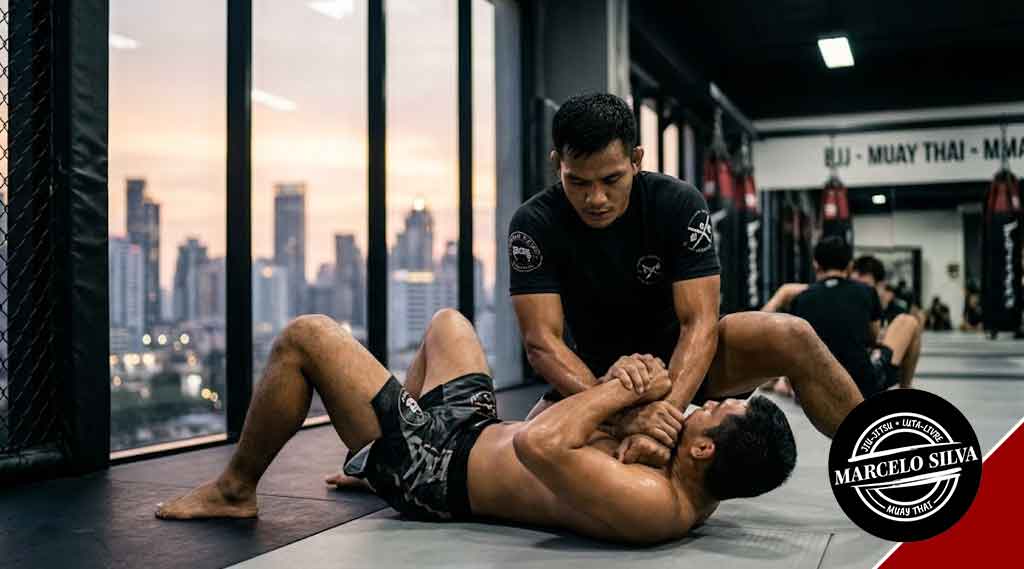
The visual showcase that transfixed combat sports audiences worldwide this past weekend at the T-Mobile Arena in Las Vegas serves as a critical case study for any athlete seeking elite progression within full-contact competition. The most discussed tactical highlight of the event was the rapid first-round technical submission, where a high-level front-headlock variation completely bypassed an opponent’s defensive posture.
This spectacular finish was not a product of chance; it stands as definitive empirical proof that when aggressive strikers or raw wrestlers attempt to pressure using explosive athleticism, implementing the structural adjustments and bone leverages of Brazilian Jiu-Jitsu functions as the ultimate equalizer inside the cage.
For dedicated martial artists, aspiring amateur competitors, and professional fighters in Thailand aiming to build an unexploitable dynamic skill set, mastering advanced ground integration is non-negotiable. Traditional striking styles or basic wrestling setups provide phenomenal physical conditioning and explosive power. However, if an athlete lacks the capacity to navigate the intricate geometric transitions of ground fighting, they remain highly vulnerable to deep choke configurations and joint locks once the battle hits the canvas.
To transition successfully into full-contact Mixed martial arts, an operator must learn to blend their standing power with a systematic, pressure-tested floor game.
Initiating your camp build at Marcelo Silva Martial Art alters your training trajectory from basic survival into targeted strategic mastery. Our academy has engineered a comprehensive tournament and fight preparation curriculum designed to secure your defensive blindspots and transform you into a complete multi-dimensional threat across the competitive network of BJJ Bangkok.
By translating elite combat physics into a highly disciplined training structure, our coaches ensure you develop the precise anatomical understanding required to dominate under the lights, making our premium facility the preferred home for high-intent fighters.
Inside the Choke Configuration: Deconstructing the Front Headlock Mechanics Behind the Peruvian Necktie
According to peer-reviewed athletic performance registers, the primary tactical error made by striking specialists transitioning into full-contact cage fighting is relying on upper-body muscular strain to clear front-headlock containment. When trapped underneath a dominant front-headlock line, attempting to use raw posture power to force an escape typically exposes the carotid arteries to immediate danger.
An educated ground fighter counters this explosive movement by executing high-level mechanical traps, wrapping their arms to isolate the neck while threading their limbs across the opponent’s thoracic spine.
[Opponent Drives For Takedown] ➔ [Secure Dominant Front Headlock] ➔ [Thread Legs Over Spine for Mechanical Lever]
To model how these positions apply extreme structural compression against the cervical vertebrae, coaches evaluate the relationship between hip extension, lever arm length, and the geometric angle of force application. The torque applied to an opponent’s spinal alignment during a front-headlock submission can be calculated through a basic mechanical leverage equation:
Where T represents the total structural torque applied to the cervical vertebrae, F_hip is the kinetic force driven by hip extension, r represents the length of the structural lever arm formed by the interlocking grip, and Φ measures the geometric angle of force application relative to the centerline.
By maximizing the lever length (r) and optimizing the angle (Φ → 90°), a smaller fighter generates devastating compression without wasting arm muscle energy, forcing an immediate technical surrender.
Training these tight positional configurations at Marcelo Silva Martial Art ensures that fighters comprehend absolute space elimination. This precise focus allows you to cleanly secure Chokehold finishes even when experiencing severe physical exhaustion from active cage fighting.
By mastering the exact skeletal mechanics of submission systems, you eliminate the need to guess under pressure, ensuring your finishes are clean, efficient, and injury-free.
Tactile Boundary Control: Reclaiming Positioning Against the Cage Mesh Using Ground Guard Layers
In professional competition, the cage fence is a powerful tool that dictates winning records. Striking specialists frequently lose spatial advantages when pressed against the boundary and taken to the canvas. Successfully escaping bottom pressure and standing back up—a process known as wall-walking—requires an intermediate understanding of Brazilian Jiu-Jitsu guard structures.
Without proper hip weight distribution and structural framing, an athlete becomes an open target for devastating ground-and-pound finishes.
[Pressed Against Fence Line] ➔ [Establish Open Guard Frames] ➔ [Shuttle Hips to Create Angle] ➔ [Execute Technical Stand-Up]
At Marcelo Silva Martial Art, our curriculum rejects passive defensive positioning in favor of teaching aggressive, forward-thinking positional control. We train athletes to use versatile guard layers to redirect incoming momentum, clear underhooks, and reverse positions to claim top control against the mesh.
This intense technical focus establishes our fight camp as the strategic training facility chosen by serious active competitors across BJJ Bangkok.
The Fight IQ Performance Matrix: Standard Sparring vs. Fight Camp Periodization
To help competitive athletes evaluate how distinct training methodologies impact their combat readiness and longevity parameters, consider this structured biological comparison:
| Combat Tactical Vector | General Multi-Gym Sparring Loops | Marcelo Silva Closed Fight Camp Meta | Long-Term Athletic Returns at Our Facility |
| Ground-to-Standing Transitions | Unstructured scrambles relying heavily on raw athletic speed | Systematic drilling of unexploitable wall-walking algorithms | Preserves core energy reserves and guarantees clean positioning |
| Submission Precision Under Load | Reliance on upper-body muscle squeezing and arm strength | Strict application of geometric bone leverage and physics | Minimizes connective tissue stress, allowing automatic execution |
| Cage Boundary Optimization | View the fence as a physical restriction or obstacle | Utilizes the mesh as an active defensive frame and lever point | Dominates spatial tracking, neutralizing aggressive wrestlers completely |
| Neuromuscular Reflex Calibration | Low (Relies on simple, repetitive combination habits) | Maximum (Demands real-time tactical adjustments under fatigue) | Stimulates high-level fight IQ, spatial awareness, and composure |
| Team Sparring Culture Profiles | High-ego gym floors with unmonitored injury risks | Regulated, technical sparring blocks with clear objectives | Maximizes your competitive lifespan, keeping your body durable |
The Biomechanical Transition: Fluidly Bridging the Gap Between Striking and Grappling
For full-contact athletes who possess a world-class foundation in stand-up arts like Muay Thai, the true challenge of transition lies within the intermediate zone—the exact moment where standing strikes morph into a wrestling clinch. Strikers who fail to understand the transitional pathways often throw strikes with improper hip positioning, leaving their center of gravity completely exposed to reactive double-leg takedowns.
Upgrading your fight architecture requires learning how to deliver strikes from a balanced, unexploitable stance.
At Marcelo Silva Martial Art, we specialize in building the kinetic bridge between vertical power and horizontal domination. Our training protocols teach you how to hide your takedown entries behind punching combinations, use underhooks to neutralize an opponent’s tie-ups, and transition into dominant floor positions without losing structural integrity.
This multi-dimensional cross-training transforms you into a highly versatile martial artist, allowing your striking and Grappling skill sets to support each other seamlessly across BJJ Bangkok.
Conclusion: Claim Your Tactical Cage Dominance in Thailand
[Prediction] By the conclusion of late 2026, the competitive martial arts landscape in Thailand will experience an unprecedented shift, transforming Bangkok into the primary regional capital for high-level full-contact preparation and tactical peaking. As the sport continues to advance, the value of a scientifically managed academy team infrastructure will fully surpass standard, uncoordinated training spaces.
pod drilling, metabolic periodization, and technical consistency form the bedrock of sustainable athletic development.
You do not have to guess your path to athletic success or rely on outdated, high-risk training models that leave your body injured and exhausted before fight night. Elevating your fight IQ and claiming your spot on the podium requires an intelligent, scientifically structured conditioning program.
Marcelo Silva Martial Art is your definitive home for elite competition development in Thailand.
Step onto our pristine, high-density training mats, master the fluid mechanics of the kinetic chain, and secure your spot inside our elite competition tracks today by exploring our specialized local programs at brazilianjiujitsubkk.com.
FAQ Section
Q1: How does practicing Brazilian Jiu-Jitsu help strikers optimize their performance inside an MMA cage?
A: The discipline teaches strikers how to utilize skeletal framing and geometric leverage to neutralize aggressive wrestlers, prevent ground-and-pound damage, and successfully stand back up against the mesh using structured wall-walking algorithms at Marcelo Silva Martial Art.
Q2: What makes the front-headlock Peruvian Necktie submission so effective against wrestling takedowns?
A: The submission converts an opponent’s forward driving momentum into a powerful mechanical trap. By wrapping the neck to isolate the carotid arteries and throwing your legs over their spine, you create an unexploitable leverage loop that forces an immediate submission across BJJ Bangkok.
Q3: I am a traditional Muay Thai fighter with zero ground experience. Will I feel out of place in this camp?
A: Not at all. Our specialized onboarding sequences are engineered specifically to help striking specialists transition their skills safely. We break down ground control into step-by-step logical systems, ensuring you build complete defensive core armor without disrupting your natural standing reflexes.
Q4: How do ground framing configurations prevent an athlete from gassing out during high-intensity rounds?
A: Framing uses your bones at precise 90-degree angles to support and redirect an opponent’s weight straight into the training mat. This biomechanical alignment unloads pressure from your muscle tissues, allowing you to conserve oxygen and maintain high processing speeds through late rounds.
Q5: What equipment or uniform is required to join the specialized full-contact fight camp sessions?
A: Practitioners require standard, high-durability grappling rash guards, form-fitting fight shorts without pockets or exposed metal zippers, and clean mouthguards. Our welcoming administrative team will provide a complete safety gear compliance checklist well before your initial session.
Q6: What is the recommended weekly training frequency to peak perfectly for a upcoming martial arts tournament?
A: Committing to three to four structured camp sessions per week is ideal to trigger optimal cardiovascular development, neuro-somatic stress adaptation, and deep technical retention without exposing your joint capsules to overtraining or muscular burnout.
Q7: How can I safely secure an introductory pass and book my first competition-level class?
A: Dedicated grapplers, competitive athletes, and health-conscious operators can easily review current training grids, check camp availability, and secure an introductory pass directly through our primary digital gateway at brazilianjiujitsubkk.com.
Don’t Just Watch—Participate!
2026 is your year to shine. Pick a date, clear your schedule, and let’s get to work. We look forward to seeing you represent our community on the podium!

 English
  ไทย
ไทย