
The Body Lock Passing Meta: Deconstructing Pelvic Immobilization and Weight Distribution in Modern Grappling | BJJ Bangkok
In modern high-level No-Gi grappling tournaments, bottom-position guard players have elevated guard retention to an exceptional standard. Leveraging flexible inversions, Reverse De La Riva frames, and K-Guard entanglements, flexible guard players frequently render traditional standing speed passes—such as the Torreando—ineffective.
When a passer remains standing at a distance, the bottom player enjoys the spatial freedom required to continuously tilt their pelvis, invert beneath the passer’s center of gravity, and enter leg entanglements.
To systematically dismantle this hyper-flexible defense, elite competitors have fully embraced the Body Lock Passing Meta.
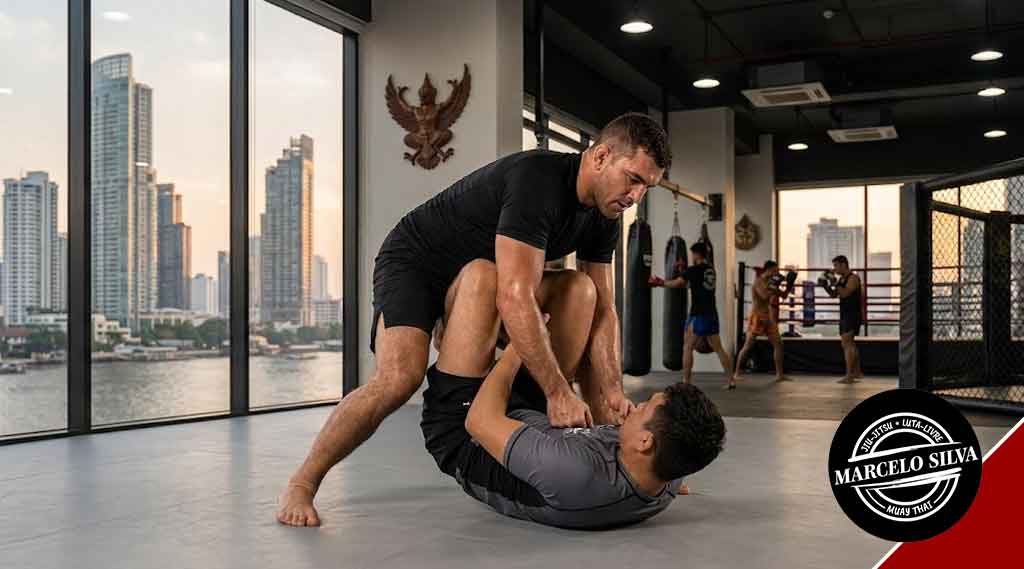
Rather than sprinting around the defender’s legs, the passer penetrates into zero distance, secures a low body lock clasp beneath the defender’s waist, establishes chest-to-chest contact, and drives horizontal pressure parallel to the mat.
This mechanic immobilizes the defender’s pelvic bowl, turning leg flexibility into a static weight liability while setting up high-percentage passes into Brazilian Jiu-Jitsu positions.
At Marcelo Silva Martial Art, we continually adapt our curriculum to reflect cutting-edge international standards. Our submission grappling programs emphasize biomechanical understanding, allowing our BJJ Bangkok community to shut down dynamic guard players with maximum efficiency.
The Flexible Guard Dilemma: Why Speed Passing Falls Short
In traditional No-Gi passing, standing up and using lateral movement was the standard approach. However, modern guard players excel at utilizing skeletal framing and hip mobility.
When a top player attempts to sprint laterally, the bottom player simply elevates their hips, inverts under the passer’s center of mass, and recovers guard or attacks the legs.
According to fundamental principles in human Anatomy, a successful inversion requires two critical conditions:
-
Pelvic Mobility: The defender’s hips must remain free to elevate off the mat and rotate along their longitudinal axis.
-
Wedge Space: There must be vertical distance between the passer’s chest and the guard player’s torso to allow leg framing and knee insertion.
[Standing Speed Pass Attempt] ➔ [Passer Leaves Vertical Distance] ➔ [Guard Player Inverts Under Hips] ➔ [Re-Guard or Leg Entanglement]
If a passer leaves vertical wedge space open, dynamic guard players will inevitably exploit it. This mechanical reality makes the Body Lock Pass essential in modern submission grappling.
Biomechanics of the Body Lock Pass: Horizontal Pressure and Hip Fixation
The Body Lock Pass relies on penetrating close distance, wrapping both arms around the defender’s low waist or pelvis using a tight Gable or Butterfly grip, flattening your chest directly against theirs, and driving forward parallel to the mat.
[Passer Penetrates Range] ➔ [Low Body Lock Clasp] ➔ [Chest-to-Chest Connection] ➔ [Horizontal Drive Parallel to Mat] ➔ [Pelvis Frozen]
Incorporating concepts from clinical Sports science, the Body Lock operates through clear mechanical rules:
-
Surface Area Pressure Distribution: By flattening chest-to-chest, the contact surface area widens significantly. Spreading force across the defender’s entire upper torso removes vertical wedge space entirely through relentless horizontal drive.
-
Elimination of Rotational Torque: Clasping the lower waist while applying upper-body chest pressure prevents the guard player from rotating their hips along their side axis. Without hip rotation, their legs cannot invert back over their head.
-
Spinal Alignment Manipulation: Positioning your head tightly under the defender’s chin or against their chest forces their cervical spine into straight alignment, physically preventing them from curling into a compact defensive ball.
Athletes at Marcelo Silva Martial Art master these pinning principles, enabling our members across BJJ Bangkok to dominate top positions with authority.
Systemic Performance Matrix: Torreando Speed Passing vs. Modern Body Lock Meta
To assist analytical combat sports practitioners in evaluating technical passing efficiency, this matrix compares traditional speed passing against our modern body lock pressure protocols:
| Tactical & Mechanical Variable | Torreando / Speed Passing | Modern Body Lock Passing Meta | Tactical Advantage Within BJJ Bangkok |
| Spatial Distance Management | Medium to Long Range (Leaves open space) | Zero Distance (Chest-to-Chest Connection) | Eliminates the space required for guard retention and inversions |
| Handling Flexible Inversions | Vulnerable to underside inversions and leg entries | Freezes pelvic rotation, preventing inversions entirely | Completely neutralizes hyper-flexible guard players |
| Energy Consumption Rate | High (demands explosive sprinting and fast footwork) | Low to Moderate (leverages body mass and gravity) | Highly sustainable over demanding competition rounds |
| Vulnerability to Heel Hooks | High (legs are left exposed at distance) | Extremely Low (legs remain tight to opponent’s hips) | Safe against Heel Hook entries and Saddle entanglements |
| Control Progression Pipeline | Must stabilize scramble after landing lateral pass | Methodical leg unweaving directly into Side Control or Mount | Connects top pressure straight into Brazilian Jiu-Jitsu dominant controls |
Methodical Passing Transitions: From Chest-to-Chest to Dominant Position
Once the defender’s hips are pinned flat against the mat, passing is no longer an explosive scramble; it becomes a systematic leg-unweaving process.
-
Clearing Butterfly Hooks: When trapped in a Body Lock, defenders often insert butterfly hooks to elevate the passer. The passer adopts a tripod stance—elevating their hips slightly while loading weight onto their head and chest—and systematically pummels their legs over the hooks before sliding directly into Side Control.
-
Direct Full Mount Transition: If the defender pinches their knees together laterally to block side passes, the Body Lock structure allows the passer to slide a knee down the center line and step directly over into Full Mount without giving up upper-body control.
Connecting standing control directly into ground Grappling sequences allows fighters at Marcelo Silva Martial Art to systematically dominate top position.
Safe Neutralization of Modern Leg Locks and Entanglements
A major benefit of the Body Lock Passing Meta is its built-in defense against leg locks. Modern leg entanglements rely on spatial distance, allowing bottom players to shoot their legs between a standing passer’s thighs.
By closing the distance chest-to-chest and keeping your hips close to the defender’s body, you eliminate the angle required for them to slip into leg lock entanglements.
Your legs remain pinned behind their hips, neutralizing submission threats before they can develop across all forms of Martial arts competition.
Advanced No-Gi Instruction at Marcelo Silva Martial Art
Mastering modern submission grappling requires a deep understanding of mechanical leverage and positional control. At Marcelo Silva Martial Art, our structured curriculum provides a complete foundation in No-Gi combat.
We integrate foundational concepts from diverse combat disciplines—including balance principles from Muay Thai and cage pressure techniques from Mixed martial arts—into our grappling system.
Our experienced black belt instructors help every student in BJJ Bangkok execute high-level pressure passing safely, technical step by technical step.
Conclusion: Take Command of Top Pressure in Bangkok
Facing a hyper-flexible guard player does not require out-sprinting them or trading risky leg entanglements. By implementing the Body Lock Passing Meta, you immobilize your opponent’s pelvis, remove spatial gaps, and turn horizontal weight distribution into an unshakeable passing system.
Upgrade your grappling performance with elite instruction in Thailand. Learn how to combine pelvic fixation, tripod balance, and dominant submission transitions under professional guidance.
Step onto the mats at Marcelo Silva Martial Art today. View our training schedules and reserve your trial session through our primary digital portal at brazilianjiujitsubkk.com.
FAQ Section
Q1: What is the Body Lock Pass in Brazilian Jiu-Jitsu?
A: The Body Lock Pass is a No-Gi pressure passing technique where the top player secures a tight clasp around the opponent’s lower waist, establishes chest-to-chest contact, and uses horizontal pressure to freeze hip rotation at Marcelo Silva Martial Art.
Q2: How does the Body Lock Pass counter hyper-flexible guard players?
A: Flexible guard players rely on hip elevation and rotation to invert. The Body Lock flattens the defender’s back against the mat and locks their pelvis, preventing them from turning or bringing their knees to their chest across BJJ Bangkok.
Q3: Is the Body Lock Pass safe against leg locks and Heel Hooks?
A: Yes. Because the Body Lock closes all spatial distance between chest and hips, it prevents the defender from inserting their legs underneath you, nullifying leg lock entries.
Q4: Can smaller grapplers effectively use the Body Lock Pass against larger opponents?
A: Absolutely. The Body Lock relies on skeletal alignment, head positioning, and horizontal drive rather than arm strength alone, making it an effective option for smaller practitioners.
Q5: How does the Body Lock transition into Full Mount?
A: When a defender squeezes their legs together to prevent lateral passes, the top player uses chest pressure to pin the defender’s upper body while sliding their knee down the midline to step easily into Full Mount in Brazilian Jiu-Jitsu.
Q6: How do I sign up for No-Gi grappling training in Bangkok?
A: Prospective practitioners and visiting grapplers can check class schedules and register for an introductory session online at brazilianjiujitsubkk.com.
Don’t Just Watch—Participate!
2026 is your year to shine. Pick a date, clear your schedule, and let’s get to work. We look forward to seeing you represent our community on the podium!


 English
  ไทย
ไทย