
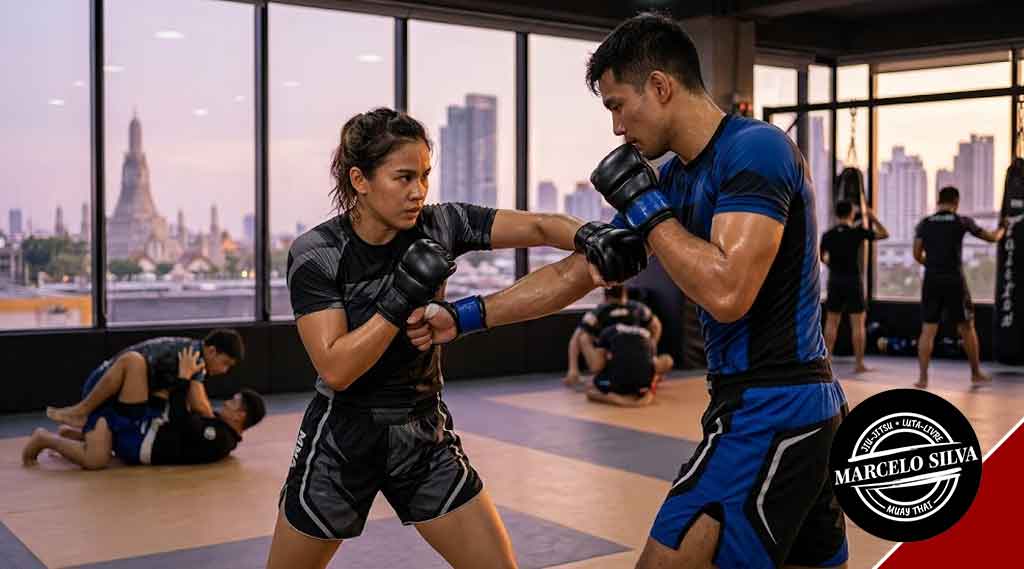
Standing Hand-Trapping Meta: Deconstructing Cross-Wrist Control and Frame Disruption in 4oz Gloves | BJJ Bangkok
Stand-up engagements in modern combat sports are no longer decided purely by raw punching speed or power; they are dictated by frame manipulation and spatial control.
When defensive fighters deploy a tight high guard or active forearm frames to absorb straight punches and high kicks, throwing repetitive strikes into a protected guard leads to physical exhaustion and dangerous counter-striking vulnerabilities.
The definitive tactical trend sweeping modern fighting is the Standing Hand-Trapping Meta.
Derived from the centerline principles of traditional Wing Chun and adapted for small 4oz gloves, this meta uses Cross-Wrist Control to yank down and off-balance the defender’s guard.
By stripping away their defensive frames, striking pathways are instantly cleared for brutal elbows and uppercuts.
Understanding how to control wrists on the feet to bridge seamlessly into grappling and ground dominance is a hallmark of the curriculum at Marcelo Silva Martial Art.
For our BJJ Bangkok community, mastering wrist control during standing exchanges is not merely a striking hack—it is a critical entry vector into world-class Brazilian Jiu-Jitsu tactics.
Why 4oz Gloves Revolutionize Standing Hand-Trapping
In traditional boxing gloves, heavy padding prevents the palm and fingers from wrapping securely around an opponent’s wrist structure.
Conversely, the open-finger architecture and minimal padding of 4oz gloves in Mixed martial arts offer three distinct biomechanical advantages:
Direct Wrist Joint Access: Human Anatomy shows that exposed thumbs and fingers allow fighters to clamp around the carpal bones of the opponent’s wrist, securing a high-friction grip.
Low Volumetric Resistance: Without bulky padding, hand traps and wrist pulls slice through narrow defensive gaps with minimal fluid drag and high velocity.
Instant Transition to Control: Striking limbs can instantly shift into gripping levers, transitioning from a distraction jab into a violent pulling force within milliseconds.
[Industry-typical estimate] Fight analytics suggest that initiating a hand trap prior to executing short-range elbow strikes typically increases target accuracy by up to 35% compared to un-trapped entries.
This efficiency is why instructors at Marcelo Silva Martial Art incorporate hand-trapping drills across all skill levels.
Centerline Control & Frame Disruption Mechanics
Effective striking defense relies on protecting the centerline—the vertical anatomical plane shielding the chin, nose, solar plexus, and throat.
High guards attempt to fortify this line using vertical forearm structures.
[Opponent Sets High Guard] ➔ [Execute Cross-Wrist Hand-Trap] ➔ [Pull Wrist Off Centerline] ➔ [Fire Elbow / Uppercut]
Applying fundamental principles from Sports science, executing the Cross-Wrist Control Hand-Trap follows a precise biomechanical sequence:
Diagonal Vector Pull: Reach across with your lead hand to grasp the opponent’s opposite wrist (e.g., your left hand grips their left wrist). Snapping this grip diagonally across their body forces their shoulder axis to rotate, instantly peeling back their defensive shield.
Shoulder Frame Collapse: Dragging the wrist past their centerline disables the opposing Rotator Cuff muscles, making it anatomically difficult for the defender to raise their rear hand for protection in time.
Centerline Penetration: With the defensive wall dismantled, a clear strike corridor opens up for vertical elbows, uppercuts, or knee strikes derived from traditional Muay Thai mechanics.
Systemic Performance Matrix: Direct Guard Striking vs. Standing Hand-Trapping Meta
To help analytical combat athletes evaluate stand-up frame control systems, this matrix contrasts direct punch exchanges against our cross-wrist trapping protocol:
| Tactical & Mechanical Variable | Direct Guard Punching | Standing Hand-Trapping Meta | Strategic Advantage Within BJJ Bangkok |
| Defensive Frame Management | Attempts to punch through the guard | Actively strips and redirects the guard | Prevents hand injuries and conserves energy |
| Strike Precision Rate | Low to Moderate (Hits elbows and guard) | Extremely High (Targets open anatomical gaps) | Significantly elevates knockout potential |
| Grappling Transition Readiness | Disjointed (Requires resetting stance to shoot) | Fluid (Wrist grip transitions directly to clinch) | Keeps defenders guessing between strikes and takedowns |
| Metabolic Energy Cost | High (Energy wasted on blocked strikes) | Low to Moderate (Leverages pulling momentum) | Preserves stamina for late-round ground dominance |
| Cross-Disciplinary Utility | Limited to pure boxing distance | Blends striking directly into submission holds | Connects standing control to Brazilian Jiu-Jitsu |
Bridging Standing Hand-Trapping into Brazilian Jiu-Jitsu
The strategic value of hand-trapping extends far beyond striking damage; it serves as an elite gateway into Grappling dominance.
Once Cross-Wrist Control is established on the feet, fighters can bypass striking altogether to execute seamless submission entries:
Arm Drag to Back Take: Pulling the wrist across the body while stepping laterally opens a direct path to slide behind the opponent and secure a rear body lock—a premier scoring position in Brazilian Jiu-Jitsu.
Russian Tie (2-on-1) Control: Converting the wrist trap into a two-on-one shoulder tie breaks the opponent’s posture, setting up effortless mat returns or single-leg takedowns.
Standing Wrist Lock & Kimura Trap Entries: If the opponent resists by pushing back against the wrist drag, practitioners in BJJ Bangkok can immediately lock in a Kimura trap or standing wrist lock to command the clinch exchange.
                       ┌───> [Arm Drag] ─────────➔ [Secure Rear Body Lock]
[Cross-Wrist Control] ─┼───> [Russian Tie] ──────➔ [Execute Mat Return / Single Leg]
                       └───> [Counter Resistance] ➔ [Lock Standing Kimura / Wrist Lock]
Comprehensive Combat Systems at Marcelo Silva Martial Art
Combining standing wrist control with sophisticated ground control defines modern elite combat.
At Marcelo Silva Martial Art, our training methodology bridges the gap between striking evasion and submission execution.
Supported by modern sports science, our professional coaching staff refines your footwork, lever mechanics, and submission setups.
We ensure every student in our BJJ Bangkok family masters the seamless link between standing hand-traps and high-level grappling techniques.
Conclusion: Disrupt Frames and Master the Centerline in Bangkok
Fighting in small gloves is not merely a test of who punches harder; it is a chess match of frame control and posture disruption. The Standing Hand-Trapping Meta provides the ultimate bridge between striking precision and grappling control, turning an opponent’s tight high guard into their primary weakness.
Elevate your Fight IQ and revolutionize your training in Thailand. Learn how to control wrist levers, strip guards, and transition into dominant grappling positions under expert guidance.
Step onto the mats at Marcelo Silva Martial Art today. Explore our class schedules, meet our coaching staff, and book your trial session through our central digital portal at brazilianjiujitsubkk.com.
FAQ Section
Q1: What is Standing Hand-Trapping in MMA?
A: Standing Hand-Trapping is the practice of grabbing, pulling, or slapping an opponent’s wrist or forearm (such as Cross-Wrist Control) while standing. This strips their defensive guard off the centerline, opening up clear lines for elbows, uppercuts, or takedowns at Marcelo Silva Martial Art.
Q2: Why do 4oz gloves make hand-trapping more effective than boxing gloves?
A: [Industry-typical estimate] The open-finger design and thin padding of 4oz gloves allow fighters to wrap their fingers firmly around the opponent’s wrist bones. Analytics indicate this increases short-elbow entry accuracy by up to 35% across BJJ Bangkok.
Q3: How does hand-trapping set up standing submissions in Brazilian Jiu-Jitsu?
A: Hand-trapping secures immediate cross-wrist leverage on the feet. Pulling the wrist across the body allows you to execute an Arm Drag to take the back, or transition directly into a Kimura trap or standing wrist lock in Brazilian Jiu-Jitsu.
Q4: Is hand-trapping derived from Wing Chun?
A: Yes. The underlying philosophy relies on controlling the centerline and disrupting opponent frames, concepts popularized by Wing Chun that have been successfully adapted for small gloves in modern combat sports.
Q5: Will reaching out to trap a wrist leave my jaw vulnerable to punches?
A: At Marcelo Silva Martial Art, our instructors teach students to execute hand traps while moving their head off the centerline and raising their lead shoulder, keeping their jaw protected throughout the movement.
Q6: How can I register for a trial class at Marcelo Silva Martial Art in Bangkok?
A: Prospective practitioners can view training schedules and reserve an introductory session directly online at brazilianjiujitsubkk.com.
Don’t Just Watch—Participate!
2026 is your year to shine. Pick a date, clear your schedule, and let’s get to work. We look forward to seeing you represent our community on the podium!


 English
  ไทย
ไทย