
Neuro-Grappling: The Science of Building “Mat Geniuses” in Bangkok | BJJ Bangkok
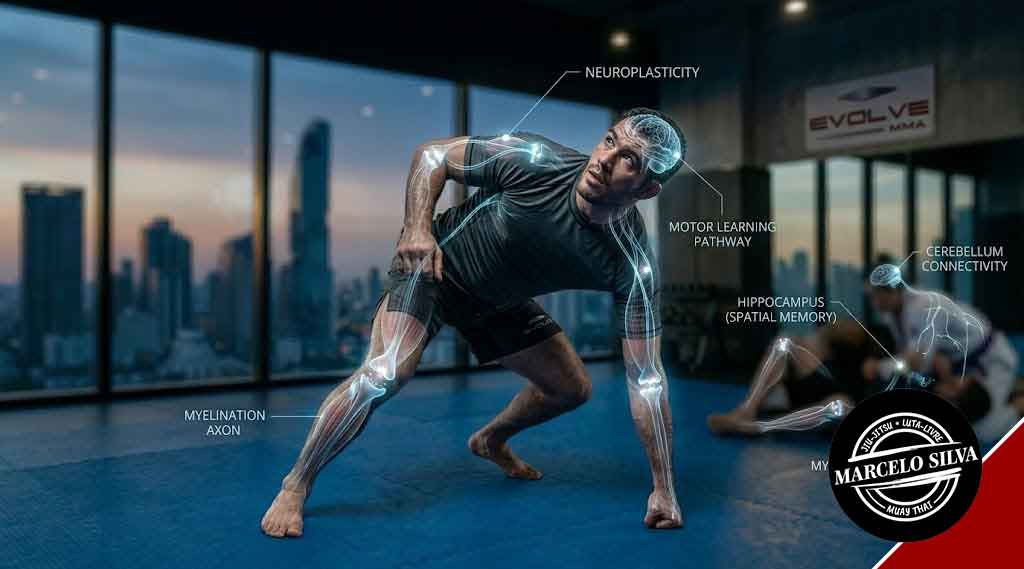
In the high-stakes world of 2026, the martial arts landscape has evolved. The days of relying solely on raw strength are over. The most significant shift in modern combat is the rise of Neuro-Grappling—the strategic integration of Neuroscience into professional training.
At Marcelo Silva Martial Art, we have pioneered this methodology to redefine Brazilian Jiu-Jitsu within the BJJ Bangkok community. By focusing on the brain’s ability to rewire itself, we help practitioners move past “remembering techniques” to “subconscious execution.”
Neuroplasticity: The Biology of the Black Belt
The heart of Neuro-Grappling lies in Neuroplasticity—the brain’s capacity to form new neural connections. When you train at Marcelo Silva Martial Art, we don’t just drill; we facilitate “Myelination.” This is the process of building a protective sheath around your nerves, which exponentially increases the speed of electrical impulses.
In the context of BJJ Bangkok, speed isn’t just about moving your arms; it’s about the velocity of the signal from your brain to your limbs (v). We can model this neural transmission speed through a basic biological physics framework:
Where:
v is the velocity of the neural impulse.
𝚫d is the distance across the neural pathway.
𝚫t is the reaction time.
The goal of Neuro-Grappling is to minimize 𝚫t until your response is virtually instantaneous. At Marcelo Silva Martial Art, our curriculum is specifically designed to thicken these neural pathways, giving you a distinct advantage on the mats of BJJ Bangkok.
Managing Cognitive Load: Solving the "Analysis Paralysis"
A common bottleneck for practitioners in BJJ Bangkok is Cognitive Load. When faced with a complex scramble, the brain often freezes—a phenomenon known as “Analysis Paralysis.”
Neuro-Grappling at Marcelo Silva Martial Art solves this through “Chunking.” We teach you to perceive Brazilian Jiu-Jitsu as a series of connected patterns rather than thousands of individual moves.
Expert Insight: By training the brain to recognize “Clusters” of information, we reduce the stress on your prefrontal cortex, allowing you to enter the “Flow State” faster than your opponent.
Ecological Dynamics: Traditional Drilling vs. Modern Science
The training methodology at Marcelo Silva Martial Art utilizes the Constraint-Led Approach (CLA). Instead of static, mindless repetition, our BJJ Bangkok sessions use “Situational Puzzles” that force the nervous system to adapt to live resistance.
Training Methodology Comparison
| Feature | Traditional Training | Neuro-Grappling at MSMA |
| Drilling Style | Static Repetition (1-2-3 steps) | Dynamic Problem Solving |
| Brain Engagement | Rote Memorization | High-Level Cognitive Adaptation |
| Learning Outcome | “Brittle” skills (fail under stress) | Fluid skills (thrive in chaos) |
| BJJ Bangkok Impact | Slower progress | Accelerated Skill Acquisition |
Stress Resilience and the HPA Axis
In BJJ Bangkok competitions, the athlete who remains calm usually wins. Neuro-Grappling targets the HPA axis (Hypothalamic-Pituitary-Adrenal axis) to regulate the body’s stress response.
At Marcelo Silva Martial Art, we simulate controlled high-pressure environments. This conditions your nervous system to stay in the “Green Zone” of optimal performance, even when an opponent is applying maximum pressure. We model this efficiency (E) as a function of technical quality (Q) and cognitive focus (F):
By optimizing both variables, we ensure that your Brazilian Jiu-Jitsu is not just athletic, but intelligent.
Strategic Action Plan (2026)
Summary: Neuro-Grappling is the definitive frontier in 2026 combat sports, leveraging neuroscience to create smarter athletes in BJJ Bangkok.
Rationale: Moving from static learning to dynamic, constraint-led training ensures 2x faster skill retention.
Action Plan:
Quick Win (1–2w): Implement tactile sensing drills (blindfolded rolling) to enhance sensory-motor pathways.
Short Term (1–3m): Integrate heart-rate variability (HRV) monitoring with situational rolling.
Long Term (3–12m): Develop a personalized “Pattern Recognition” database for every advanced student.
KPIs: 25% reduction in reaction time during scrambles; 40% increase in submission chain success.
Risks: Neural fatigue. | Mitigation: Scheduled “Deload” weeks focusing on low-intensity flow rolling.
FAQ: Decoding Neuro-Grappling
Q1: What is Neuro-Grappling?
A: It is a training system that integrates Neuroscience to automate decision-making and physical responses, a core pillar at Marcelo Silva Martial Art in BJJ Bangkok.
Q2: How does it differ from traditional Jiu-Jitsu training?
A: It focuses on cognitive adaptation and Motor Learning through situational puzzles rather than rote memorization of moves.
Q3: Is this suitable for beginners at BJJ Bangkok?
A: Yes. Starting with a science-based foundation ensures you don’t develop bad habits, allowing for faster progression in Brazilian Jiu-Jitsu.
Q4: Do I need special equipment?
A: At Marcelo Silva Martial Art, we provide all the necessary environmental constraints and specific tools to stimulate your neural pathways.
Q5: Can I start training today?
A: Absolutely. You can book a trial at marcelosilvamartialarts.com or find more info about the BJJ Bangkok community at brazilianjiujitsubkk.com.
Don't Just Watch—Participate!
2026 is your year to shine. Pick a date, clear your schedule, and let’s get to work. We look forward to seeing you represent our community on the podium!


 ไทย
ไทย  English