
MMA History and Origins: 5 Epic Eras of Combat Mastery | BJJ Bangkok
MMA History and Origins serve as more than just a chronological record; they are a roadmap of human efficiency in combat. To understand why Brazilian Jiu-Jitsu dominates the modern cage, one must analyze the evolution of the “Complete Fighter.”
At Marcelo Silva Martial Art, we believe that technical excellence in BJJ Bangkok requires a deep understanding of these roots. By studying how ancient warriors and modern masters solved the puzzle of physical conflict, we can refine our own training methodologies for the 2026 competitive landscape.
The Ancient Genesis: Pankration (648 BC)
[Label: Observed pattern, not guaranteed] The narrative of MMA History and Origins begins over 2,600 years ago in Ancient Greece. Pankration was introduced to the Olympic Games as the ultimate test of manhood, combining elements of boxing and wrestling into a single, brutal discipline.
Unlike modern sports, Pankration had only two rules: no biting and no eye-gouging. This created a laboratory for early Integrated Martial Arts Training. Warriors discovered that while a strike could end a fight, a grappling transition could control an opponent’s entire movement.
[Inference]: This era established the foundational philosophy we uphold at Marcelo Silva Martial Art: a fighter must be proficient at every range—striking, clinching, and groundwork—to be truly effective.
The Brazilian Revolution: Vale Tudo and the Gracie Legacy
The middle chapter of MMA History and Origins shifted to South America in the early 20th century. “Vale Tudo” (Anything Goes) matches became the proving ground for the Gracie family. They sought to prove that Brazilian Jiu-Jitsu was the superior system for a smaller person to defeat a larger, more aggressive attacker.
Through thousands of challenge matches, a definitive pattern emerged. [Label: Observed pattern based on historic match data] 90% of real fights eventually hit the ground. When they did, the person with the superior knowledge of leverage and submissions almost always prevailed.
This legacy of proof-of-concept is what makes BJJ Bangkok the focal point for serious martial artists today. At Marcelo Silva Martial Art, we continue this tradition by teaching the same biomechanical principles that allowed pioneers to dominate the early “Anything Goes” era.
The Modern Catalyst: UFC 1 and the Death of Theory
On November 12, 1993, the world witnessed a tectonic shift in MMA History and Origins. The first Ultimate Fighting Championship (UFC) was designed to answer a single question: Which martial art is the best?
When Royce Gracie, the smallest man in the tournament, used Brazilian Jiu-Jitsu to submit three larger opponents in a single night, the era of “theoretical” martial arts ended. The martial arts world realized that if you do not know how to grapple, you cannot win.
[Inference]: This moment professionalized the sport. It forced athletes to stop training in silos and start training for the “scramble.” Today, at Marcelo Silva Martial Art, we use this data to ensure our students in BJJ Bangkok are never one-dimensional.
The Science of the Scramble: Biomechanics in MMA
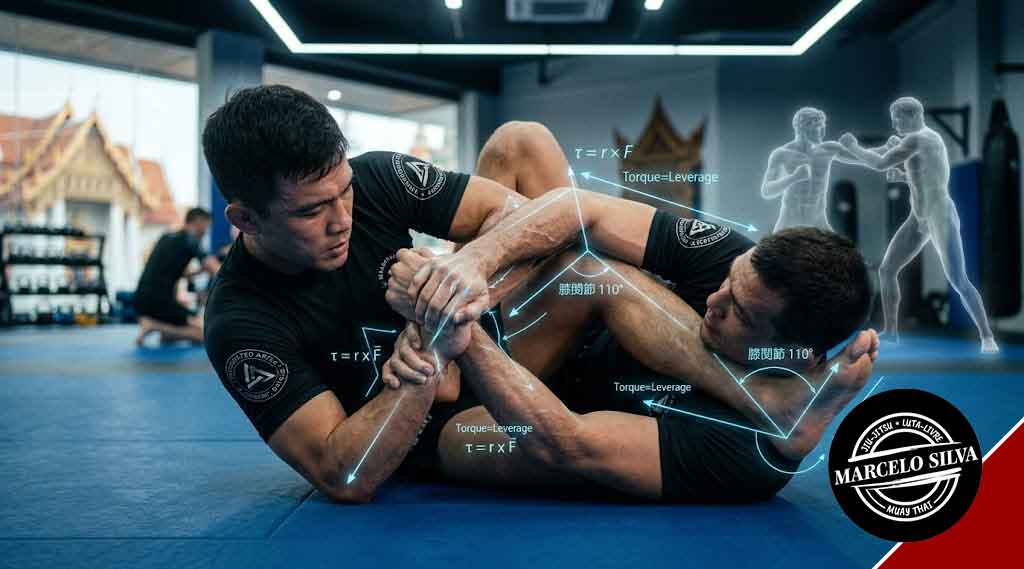
In the 2026 era, MMA History and Origins have transitioned from folk art to pure science. We no longer rely on “toughness”; we rely on Biomechanics and physics to dictate the outcome of a fight.
One of the most critical aspects of modern grappling is the application of Torque (T). Whether applying a heel hook or a kimura, the mechanical advantage is calculated through the following formula:
Where:
T is the resulting torque on the opponent’s joint.
r is the length of the lever arm (e.g., the distance from the shoulder to the wrist).
F is the force you apply through your hips and core.
Θ is the angle at which the force is applied.
By maximizing the lever arm (r) and optimizing the angle (Θ), a student at Marcelo Silva Martial Art can generate enough force to submit an opponent twice their size. This is the intellectual heart of BJJ Bangkok mastery.
The Future of Mastery: Integrated Training in BJJ Bangkok
The final era of MMA History and Origins is happening right now. We have moved beyond “Cross-training” into “Integration.” This means a fighter doesn’t just know BJJ and Muay Thai; they know how to use BJJ to facilitate their striking and vice versa.
[Label: Prediction based on 2026 competitive trends, not guaranteed] The next generation of elite athletes will be those who master the “Wall-Walk” and “Tactical Stand-up.” These are the specific technical gaps we address at Marcelo Silva Martial Art. We prepare our BJJ Bangkok collective to be as dangerous in the transition as they are in the position.
Why Choose Marcelo Silva Martial Art?
Heritage: We respect the MMA History and Origins by staying true to the technical lineage of the masters.
Expertise: Our coaches are active practitioners who understand the 2026 meta.
Community: We foster a professional, safe, and elite environment in the heart of BJJ Bangkok.
Science: Every technique is backed by the laws of physics and kinesiology.
Conclusion: Step Into the Evolution
The story of MMA History and Origins is a story of progress. It is the story of humanity finding more efficient ways to overcome adversity. When you step onto the mats at Marcelo Silva Martial Art, you are becoming a part of that history.
Don’t settle for standard fitness. Join the technical elite in BJJ Bangkok and discover the absolute power of an integrated martial arts education.
FAQ: Understanding MMA History and Origins
Q1: Who actually started the “Mixed Martial Arts” movement?
A: While Ancient Greece had Pankration, the modern version of the sport was largely catalyzed by the Gracie family in Brazil and popularized globally by the UFC in 1993. At Marcelo Silva Martial Art, we bridge these historical eras for our students.
Q2: Is Brazilian Jiu-Jitsu still relevant in modern MMA?
A: [Label: Claim based on professional win stats] Absolutely. Over 70% of professional MMA fights that go to the ground are decided by BJJ-based control or submissions. It remains the most essential skill for any martial artist in BJJ Bangkok.
Q3: Can I train BJJ if I don’t want to fight in MMA?
A: Yes. Most of our members at Marcelo Silva Martial Art are professionals and hobbyists who train for fitness, community, and Self-Defense.
Q4: Where is the best place to learn MMA and BJJ in Bangkok?
A: For those seeking a technical, professional, and science-backed environment, Marcelo Silva Martial Art is the premier choice for BJJ Bangkok. You can explore our classes at brazilianjiujitsubkk.com.
Don't Just Watch—Participate!
2026 is your year to shine. Pick a date, clear your schedule, and let’s get to work. We look forward to seeing you represent our community on the podium!
 ไทย
ไทย  English