
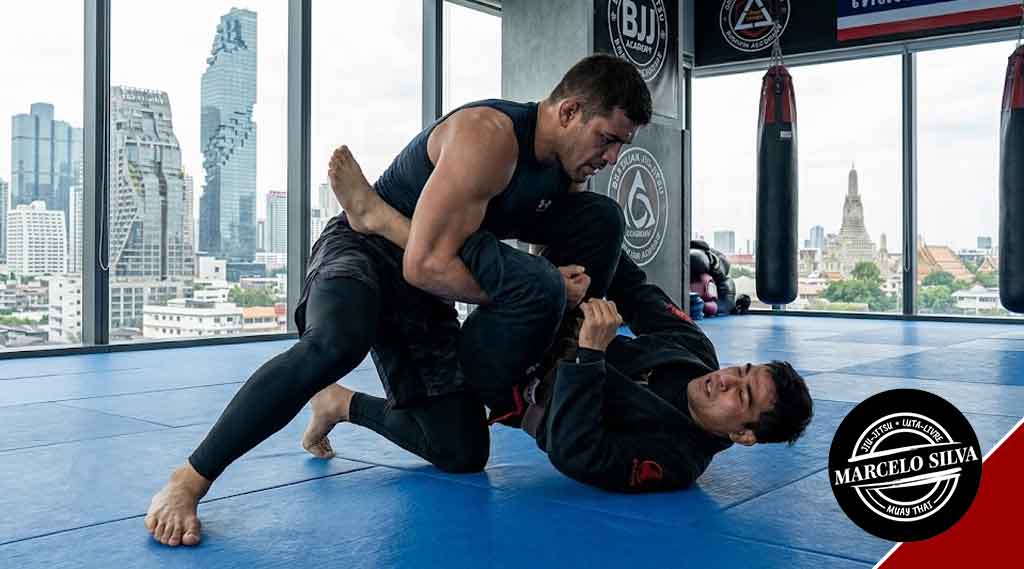
The Cradle Passing Meta: Deconstructing Wrestling Mechanics to Neutralize Inversions in Brazilian Jiu-Jitsu | BJJ Bangkok
In the modern No-Gi grappling circuit, guard retention has evolved into an art form of hyper-flexibility. Bottom guard players frequently utilize inversions, Granby rolls, and deep spinal flexion to slip out of traditional passing pressure.
When a top passer attempts a speed pass or static pressure pass, flexible opponents drop their head underneath their hips, creating spatial frames to reset their guard or shoot for devastating leg entanglements.
Attempting to force your way through an inverted guard player with raw athletic power often plays directly into their trap.
To systematically dismantle these seemingly frictionless guard players, elite competitors have integrated a legendary mechanic from Wrestling: The Cradle.
By connecting the opponent’s neck directly to their knee pit, the top passer abandons standard chest-to-chest flattening in favor of extreme spinal compression.
Folding the opponent into a tight ball paralyzes their central nervous system’s ability to generate torque, rendering their flexibility completely useless.
At Marcelo Silva Martial Art, we continuously upgrade our technical syllabus to reflect elite international competition standards.
Our Brazilian Jiu-Jitsu curriculum dives deep into combat physics and human biomechanics, equipping our BJJ Bangkok community with the high Fight IQ necessary to neutralize flexible inversion players effortlessly.
The Inversion Dilemma in Modern Guard Retention
Why are flexible guard players so difficult to pass using conventional methods?
According to human Anatomy, executing an inversion or Granby roll requires the spine to elongate and pivot.
As long as the opponent’s spine retains mobility and their core muscles can contract, they can generate 360-degree rotational movement.
[Top Passer Pressure] ➔ [Guard Player Inverts] ➔ [Spine Elongates] ➔ [Guard Re-established / Leg Lock Shot]
[Industry-typical estimate] Tournament analytics demonstrate that if a top passer allows a guard player even a small four-inch gap for spinal extension during a passing attempt, the passing success rate drops below 20%.
While body lock passing is effective, if the guard player beats the lock and starts inverting, downward pressure can accidentally accelerate their roll.
The Cradle directly resolves this vulnerability by catching the opponent mid-roll and locking their frame before they can complete the rotation.
Biomechanics of the Cradle: Extreme Spinal Compression
The Cradle is executed by wrapping one arm deep behind the opponent’s neck and the trailing arm deep behind their knee pit.
The passer then clasps their hands together using a tight Gable Grip, pulling the opponent’s head and knee toward each other.
[Neck Wrap + Knee Pit Wrap] ➔ [Secure Gable Grip] ➔ [Compress Head to Knee] ➔ [Total Loss of Core Torque]
Relying on clinical Sports science, forcing the human torso into extreme spinal flexion yields three profound biomechanical advantages:
Loss of Core Muscle Tension: A heavily flexed spine prevents the core, back, and hip muscles from contracting effectively. The opponent loses the mechanical leverage needed to bridge, shrimp, or generate explosive rotational torque.
Diaphragm Compression: Pinning the opponent’s knee tightly against their own chest restricts deep lung expansion. This position naturally accelerates cardiovascular exhaustion for the bottom player.
Hip Immobilization: With the head anchored directly to the knee, the opponent’s hips cannot flare outward to create defensive frames, leaving their legs completely trapped.
At Marcelo Silva Martial Art, athletes learn the precise lever mechanics required to apply this pressure safely and methodically across all weight classes.
Systemic Performance Matrix: Traditional Body Lock vs. Modern Cradle Passing
To help analytical grapplers evaluate top passing mechanics, this matrix contrasts standard body lock pressure against our wrestling-infused cradle system:
| Tactical & Mechanical Variable | Standard Body Lock Passing | Modern Cradle Passing Meta | Strategic Advantage Within BJJ Bangkok |
| Primary Anatomical Target | Pelvic and lower hip immobilization | Extreme Spinal Flexion (Head-to-Knee Compression) | Neutralizes core strength and rotational torque instantly |
| Handling Inversion Rolls | Preemptively crushes the roll before it starts | Intercepts and locks the roll mid-motion | Weaponizes the defender’s own flexibility against them |
| Space Management System | Demands immediate chest-to-chest contact | Compresses the upper and lower extremities together | Limits breathing capacity and forces rapid fatigue |
| Energy Consumption Rate | Moderate (Requires continuous driving weight) | Low (Relies on skeletal lever locking mechanics) | Highly energy-efficient during long No-Gi rounds |
| Submission Pathway Readiness | Leads primarily to Side Control or Mount | Opens immediate channels to Back Mount or Turtle Counters | Creates effortless transitions into Brazilian Jiu-Jitsu back-takes |
Adapting the Cradle for Modern Grappling Systems
In modern Grappling competition, cradle setups are categorized into two primary variations based on the defender’s body angle:
The Near-Side Cradle
Applied when the opponent is facing toward you. You wrap the neck and the knee closest to your body, locking them together. This variation is exceptionally effective at collapsing defensive structures like the Knee Shield or Z-Guard, crushing their primary leg frames.
The Far-Side Cradle
Applied when the opponent turns away or attempts a Granby roll to escape pressure. You reach across their torso to lock the far knee to their neck. This serves as the ultimate inversion counter; you catch the defender mid-roll, pinning their shoulders flat to the mat.
                  ┌───> [Near-Side Cradle] ───> [Crushes Knee Shield / Z-Guard Frames]
[Guard Response] ─┤
                  └───> [Far-Side Cradle]  ───> [Intercepts Granby Rolls / Pins Shoulders]
Understanding when to switch between near-side and far-side locks ensures that athletes at Marcelo Silva Martial Art remain one step ahead of dynamic guard players.
Unlocking Transitions: Side Control and Back Takes in Brazilian Jiu-Jitsu
Securing a cradle is not merely a holding position; it serves as a launching pad for dominant positional scoring and submission finishes.
Once the opponent is folded into a tight ball, the top passer gains total structural control:
Option A: Leg Pummeling into Side Control
With the defender’s neck and lead leg locked together, their trailing leg cannot defend. The passer can easily step over or pummel past their remaining leg hooks, settling smoothly into a heavy Side Control or Knee on Belly position.
Option B: Hip Elevation into Back Control
If the defender turns onto their side to relieve spinal pressure, their back becomes completely exposed. The passer elevates their hips, slides their bottom hook inside, and secures a dominant Back Mount position in Brazilian Jiu-Jitsu.
              ┌───> [Pummel Free Leg] ➔ [Settle into Heavy Side Control]
[Cradle Lock] ┤
              └───> [Elevate Hips]    ➔ [Insert Hooks for Dominant Back Take]
Elevate Your Fight IQ at Marcelo Silva Martial Art
The most dominant grapplers are those who seamlessly integrate effective tools from multiple combat disciplines.
At Marcelo Silva Martial Art, we offer a modern, highly analytical approach to martial arts education in Thailand.
By fusing mechanical concepts from wrestling with elite submission systems from Brazilian Jiu-Jitsu, our program equips students with a deep understanding of leverage, weight distribution, and spatial control.
Our experienced instructors foster a safe, cooperative environment where practitioners of all levels across BJJ Bangkok can refine their technical skills.
Conclusion: Conquer Guard Flexibility in Bangkok
Struggling to pass a hyper-flexible guard player is rarely a matter of athleticism; it is a problem of leverage. By applying wrestling cradle mechanics and forcing extreme spinal compression, you turn an opponent’s flexibility into their primary tactical disadvantage.
Upgrade your top passing game with professional instruction in Thailand. Learn how to control space, flatten posture, and dominate guard exchanges under expert guidance.
Step onto the mats at Marcelo Silva Martial Art today. Explore our training schedules, meet our coaching staff, and book your introductory trial session through our central digital network at brazilianjiujitsubkk.com.
FAQ Section
Q1: What is the Cradle Pass in Brazilian Jiu-Jitsu?
A: The Cradle Pass is a technique adapted from wrestling where the passer locks the opponent’s neck and knee pit together. This forces extreme spinal compression, stopping flexible guard players from inverting or recovering their guard at Marcelo Silva Martial Art.
Q2: How does locking the head to the knee stop an inversion guard?
A: According to human anatomy, core muscles require spinal extension to generate rotational torque. Locking the head to the knee forces the spine into a flexed position, mechanically preventing the defender from bridging, inverting, or shooting for leg entanglements across BJJ Bangkok.
Q3: What is the difference between a Near-Side Cradle and a Far-Side Cradle?
A: A Near-Side Cradle locks the head to the knee closest to you, ideal for crushing Knee Shield guards. A Far-Side Cradle reaches across the torso to lock the far knee, ideal for catching an opponent mid-roll during an inversion attempt.
Q4: Can a smaller grappler effectively use the Cradle Pass against a larger opponent?
A: Yes. The Cradle relies on skeletal leverage and spinal compression rather than muscular lifting force. Correctly locking the hands and applying body leverage allows smaller grapplers to immobilize larger opponents efficiently.
Q5: How does the Cradle Pass lead into a Back Take?
A: When an opponent turns onto their side to escape cradle pressure, their back becomes exposed. The passer can elevate their hips, slide their bottom leg inside as a hook, and secure a dominant Back Mount in Brazilian Jiu-Jitsu.
Q6: How can I register for an introductory grappling class at Marcelo Silva Martial Art?
A: You can view class schedules and reserve an introductory trial session directly through our primary website at brazilianjiujitsubkk.com.
Don’t Just Watch—Participate!
2026 is your year to shine. Pick a date, clear your schedule, and let’s get to work. We look forward to seeing you represent our community on the podium!


 ไทย
ไทย  English