
The Next-Gen Leg Entanglement & Inversion Meta: Lessons from ADCC Youth World Championship & Austin Open 2026 | BJJ Bangkok
On the weekend of August 8–9, 2026, the grappling world witnessed two landmark events that showcased the rapid evolution of No-Gi Grappling: the ADCC Submission Wrestling World Championship Youth World 2026 and the ADCC Austin Open. What stood out was the biomechanical sophistication displayed by next-generation grapplers. Younger competitors demonstrated seamless integration of dynamic guard retention via inversions and proactive leg entanglement chains, fundamentally shifting the No-Gi meta.
Key takeaways from these events prove that top pressure passers attempting heavy Body Lock passes can no longer easily flatten modern guard players. Today’s next-gen athletes utilize structural bone framing combined with fluid hip mobility (pivoting and inversions) to absorb heavy chest-to-chest pressure, while simultaneously firing early-entry leg lock chains (K-Guard & False Reap) from the bottom.
At Marcelo Silva Martial Art, we are dedicated to bringing world-class competition metas to our local mats in Thailand. Deconstructing high-level technical innovations from ADCC 2026 allows practitioners in our BJJ Bangkok community to understand human mechanics, enabling them to execute modern Brazilian jiu-jitsu techniques with high efficiency and minimal effort.
Dynamic Guard Retention: Neutralizing Body Lock Pressure via Bone Framing
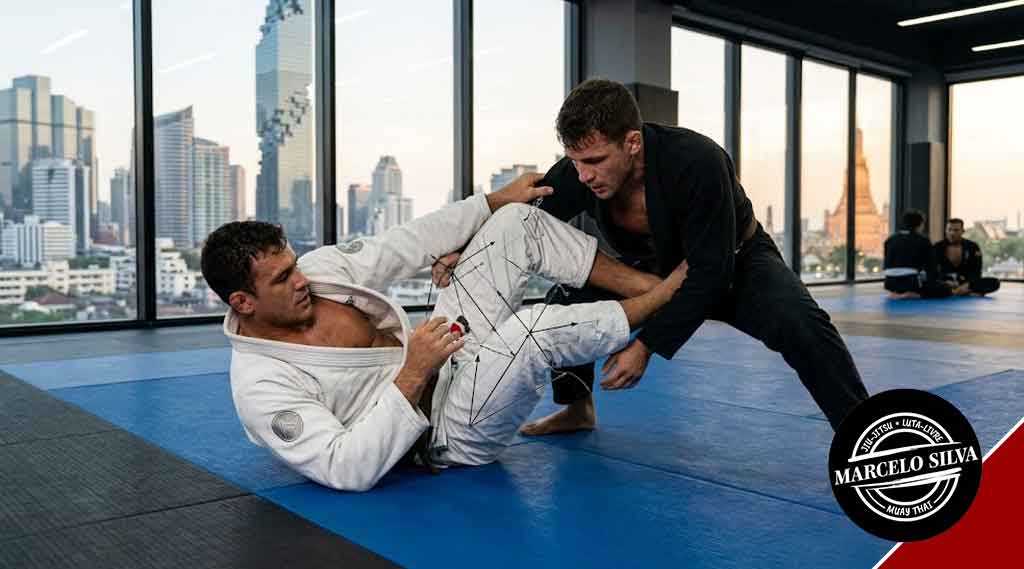
In the ADCC Youth 2026 matches, when heavy top passers initiated low Body Lock passes to flatten the guard, next-gen athletes avoided muscling back against the pressure. Instead, they applied structural bone framing and lateral hip pivoting.
According to human Anatomy, placing a shin block or forearm frame aligned parallel with the opponent’s pelvic girdle redirects linear downward force directly into the mat, preserving spinal mobility.
The Biomechanical Flow: Passer Initiates Body Lock ➔ Set Shin & Arm Bone Frame ➔ Transfer Pressure to Mat ➔ Execute 180-Degree Inversion ➔ Re-Guard or Attack
This dynamic guard retention operates through three precise mechanical phases:
-
Skeletal Framing: Aligning the forearms and shins across the passer’s chest and pelvis maintains wedge space, keeping the hips unpinned.
-
Axial Inversion: As the passer drives forward, the guard player elevates their hips and tucks their head under the passer’s center of mass, executing a smooth 180-degree inversion.
-
Re-Guarding & Counter-Attacking: Once the hips clear the passing lane, the free leg is pummeled back inside to reset the guard or establish an immediate leg entanglement entry.
Mastering hip mobility and structural framing is a core focus at Marcelo Silva Martial Art, equipping athletes across BJJ Bangkok to defend against heavier opponents safely.
Early Entry Leg Lock Chains: Countering Heavy Base Stances with K-Guard and False Reap
Another technical highlight from the ADCC Austin Open 2026 was the proactive deployment of “Early Entry Leg Lock Chains.” Instead of waiting for top passers to establish passing grips, next-gen guard players attack the lower quadrant the moment the passer sets a low, heavy base stance.
Training leg entanglements proactively has established a new competitive standard, neutralizing standing and kneeling pressure via two primary pathways:
-
Early K-Guard Entry: As the passer crouches low to initiate a pass, the bottom player scoops under the far knee pit, extending their top leg across the passer’s back. This early entry forces the passer onto the defensive, threatening a Matrix Back Take or leg isolation.
-
False Reap Connection: If the passer retracts their hips to clear the K-Guard, the bottom player hooks the outside ankle with a False Reap. Generating horizontal rotational torque forces the passer’s lead knee to collapse inward, dismantling their stance and opening a direct pathway into the Honey Hole or Saddle position.
Integrating these proactive leg entanglements allows modern practitioners to transform defensive guard retention into immediate offensive dominance in Grappling.
Strategic Comparison Matrix: Traditional Guard Retention vs. Next-Gen ADCC Meta
| Technical Metric | Traditional Guard Retention | Next-Gen ADCC Meta (Youth 2026) | Tactical Advantage in No-Gi |
| Body Lock Defense | Muscular pushing against linear pressure | Skeletal Bone Framing & Inversion | Neutralizes heavy top pressure without expending stamina |
| Leg Lock Entry Timing | Reactive (initiated after passer closes distance) | Proactive Early Entry (K-Guard / False Reap) | Forces heavy passers onto the defensive immediately |
| Counter-Force Direction | Vertical pushing | Planar rotational torque | Dismantles heavy base stances of larger opponents |
| Positional Transitions | Resetting to standard Closed/Open Guard | Direct transition to Back Takes or Saddle | Converts defense into high-percentage submission entries |
Translating ADCC 2026 Competition Metas into Mat Mastery
Studying international competition confirms that Brazilian jiu-jitsu is constantly evolving. Deconstructing verified tournament techniques from ADCC Youth World 2026 into accessible training concepts is a primary mission at Marcelo Silva Martial Art.
Grounded in principles of Sports science, learning advanced mechanics like inversions and leg entanglements requires progressive joint mobility and strict tap-awareness protocols. Whether you are a dedicated competitor or a recreational practitioner in BJJ Bangkok, biomechanically sound instruction accelerates skill acquisition while preventing injury.
Elevate Your No-Gi Game at Marcelo Silva Martial Art
Whether you train in Brazilian Jiu-Jitsu for sport competition, fitness, or to enhance your ground competence for Mixed martial arts (MMA), learning within a world-class, updated curriculum is essential.
Marcelo Silva Martial Art welcomes practitioners of all skill levels across BJJ Bangkok. Our professional coaching staff delivers step-by-step instruction in skeletal framing, safe inversion mechanics, and proactive leg lock chains (K-Guard & False Reap), empowering you to perform with absolute confidence on the mats.
Conclusion: Embrace Modern BJJ Innovation in Bangkok
The technical breakdowns from the ADCC Youth World Championship and Austin Open 2026 prove that biomechanical innovation is the key to modern grappling success. Embracing next-generation metas expands your guard retention and submission capabilities infinitely.
Master modern No-Gi grappling mechanics with world-class guidance. Step onto the mats at Marcelo Silva Martial Art, enroll in our specialized programs today, and revolutionize your performance in BJJ Bangkok!
FAQ Section
Q1: What is the leg entanglement meta in modern Brazilian Jiu-Jitsu?
A: The modern leg entanglement meta focuses on proactive, early-entry attacks—such as the K-Guard and False Reap—to immediately neutralize a top passer’s heavy base and secure high-percentage submissions like heel hooks before the opponent can settle into a passing position.
Q2: How do modern grapplers defend against a heavy Body Lock pass?
A: Instead of using muscular strength to push back, modern grapplers use skeletal bone framing (aligning forearms and shins across the passer’s chest and pelvis) combined with 180-degree hip inversions to transfer the downward pressure directly into the mat and easily recover their guard.
Q3: What did the ADCC Youth 2026 tournament reveal about No-Gi grappling?
A: It revealed a massive biomechanical shift where next-generation athletes prioritize fluid hip mobility, proactive leg lock chains, and structural framing over brute force, completely neutralizing traditional heavy pressure passing styles.
Q4: What is a False Reap in No-Gi grappling?
A: A False Reap is an advanced leg entanglement entry where the bottom player hooks the opponent’s outside ankle. By generating horizontal rotational torque, it forces the opponent’s lead knee to collapse inward, opening a direct pathway into the dominant Saddle position.
Q5: Why is bone framing more effective than pushing against a top passer?
A: Pushing relies on muscle contraction, which quickly drains cardiovascular energy under heavy weight. Bone framing aligns your skeletal structure to bear the load mechanically, requiring almost zero muscular exertion to maintain distance.
Q6: Are inversions and modern leg locks safe for beginners to learn?
A: Yes, when taught with proper methodology. At Marcelo Silva Martial Art, beginners are introduced to inversions and leg entanglements through progressive joint mobility exercises and strict safety-tap awareness to ensure injury-free development.
Q7: How can I start learning ADCC-level Brazilian Jiu-Jitsu in Bangkok?
A: You can start your journey by booking an introductory trial class at Marcelo Silva Martial Art. Visit our official website at brazilianjiujitsubkk.com to view our class schedule and join the premier BJJ community in Bangkok.
Don’t Just Watch—Participate!
2026 is your year to shine. Pick a date, clear your schedule, and let’s get to work. We look forward to seeing you represent our community on the podium!
 ไทย
ไทย  English