
MMA and The Kinetic Link Blueprint: Deconstructing the Biomechanics of Force Transfer Without Momentum Loss | BJJ Bangkok
The technological evolutions circulating inside premium global combat networks this past week have triggered immense engagement metrics regarding physical biohacking. High-definition slow-motion analyses of elite champions operating within Mixed Martial Arts (MMA) environments have fundamentally challenged common fitness misconceptions. The evidence proves that devastating punch velocity is not generated by the isolated muscle tissue of the arm or the anterior deltoid.
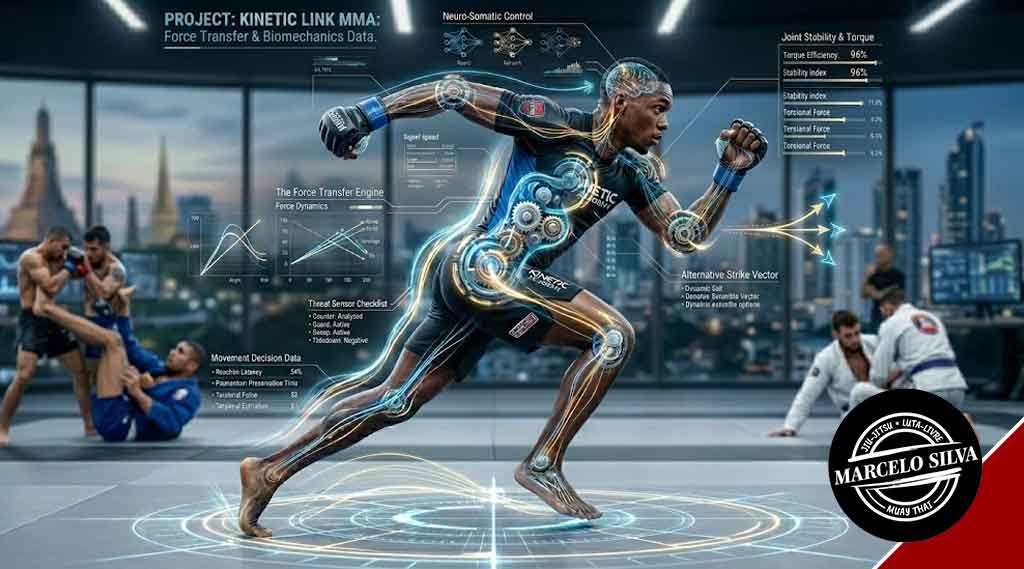
Instead, high-level structural impact relies on a continuous biomechanical loop known within Sports Science databases as the “Kinetic Chain”—the seamless accumulation of force driven from the foot plant on the mat, multiplied by hip rotation, stabilized by the core, and released through the lead knuckles with zero loss of linear momentum.
For executive directors, corporate operators, and digital workers residing in Thailand, decomposing this architectural movement system offers a highly practical solution for somatic dysfunction. Training your kinetic chain channels transcends the boundaries of standard self-defense fitness. It reconfigures human functional coordination, enabling your anatomical frame to move with balance, athletic carriage, and absolute resilience in everyday life.
Fusing these striking dynamics with the geometric floor principles of Brazilian Jiu-Jitsu creates an elite fitness matrix, addressing both vertical combat efficiency and ground positional mastery.
As an international benchmark for motion biomechanics, Marcelo Silva Martial Art specializes in delivering ergonomics-based programs. This elite structure helps lifestyle seekers operating across the BJJ Bangkok circuit achieve premium functional transformation under rigorous safety parameters.
The Physical Laws of Striking: Mapping Kinetic Travel from Earth to Target
From the strict academic standpoint of advanced movement mechanics, force output does not materialize out of thin air. It operates directly under principles derived from Newton’s Laws of Motion, which state that when an object exerts a specific force onto a surface, that surface simultaneously returns an equal force back in the opposite direction. Within a standard straight punch configuration inside Mixed Martial Arts (MMA), this physical kinetic journey is divided into four distinct anatomical stations:
-
The Structural Anchor: The practitioner drives their trailing metatarsals into high-density mats to harness ground reaction force. A stabilized lower-stance base determines the magnitude of incoming energy.
-
The Pelvic Leverage Axis: Vertical force traveling through the patellar complex is converted into angular torque via rapid, explosive hip rotation.
-
The Core Transfer Hub: The transverse abdominis, obliques, and lumbar stabilizers constrict simultaneously to act as a rigid structural bridge. A loose core complex leaks force output, disrupting mechanical leverage.
-
The Scapular Release: In the terminal phase, the limb muscle tissue acts strictly as a low-tension delivery conduit, driving the accumulated kinetic mass toward the target centerline.
A critical error common among introductory hobbyists is muscular contraction of the arm during punch initiation, which slows delivery speed and causes early shoulder joint impingement. The training methodologies implemented at Marcelo Silva Martial Art systematically dismantle tense movement habits, replacing them with fluid physics principles. This focus on bio-mechanical alignment stands as the core methodology underlying our development within the premium BJJ Bangkok sector.
Erasing Occupational Degeneration: Why Kinetic Integration Outperforms Static Weights
Standard weight training programs rely almost entirely on isolated single-joint movements, such as a seated bicep curl. While effective for localized hypertrophy, these routines fail to condition neuromuscular coordination for real-world scenarios. This limitation stands in stark contrast to the dynamic multi-joint requirements found inside professional Mixed Martial Arts (MMA) conditioning.
[Foot Drives into Floor] ➔ [Hip Rotates 90 Degrees] ➔ [Core Constricts Rigidly] ➔ [Punch Implodes on Target]
Mechanical Outcome: Bypasses isolated muscle strain and distributes joint loads safely.
[Prediction] By the conclusion of late 2026, premium wellness communities will shift completely away from single-muscle workouts, embracing integrated physical kinetic flows instead. Combining structural striking work with the technical systems of Brazilian Jiu-Jitsu conditions the stabilizing muscle groups surrounding the vertebral column.
This multi-planar approach active aligns posture, expands chest flexibility, and reverses chronic office-chair slouching, setting a new physical standard for urban professionals training inside the premium BJJ Bangkok network at Marcelo Silva Martial Art.
The Ergonomic Calibration Matrix: Single-Muscle Isolation vs. Integrated Kinetic Chains
| Physical Attribute Profile | Isolated Weight Training (Static Gyms) | Integrated Kinetic Systems (Mixed Martial Arts (MMA) Lab) | Real-World Return Crossover Within BJJ Bangkok |
| Primary Energy Generation Source | Localized muscle tissue contraction (Triceps/Shoulders) | Ground reaction force combined with full pelvic rotation | Generates immense structural force with minimal localized fatigue |
| Joint Articulation Safety Profile | High localized stress concentrated on single joint capsules | Forces distributed evenly across the entire skeletal column | Minimizes acute wear, making it excellent for mature professionals |
| Caloric Consumption Efficiency | Low to moderate (Activates limited muscle groups concurrently) | Maximum (Demands full-body muscular synchronization) | Fast-tracks metabolic fat loss and builds a highly functional, lean physique |
| Neuromuscular Coordination Output | Linear, predictable movements in single planes | Dynamic, multi-planar spatial problem solving | Enhances spatial awareness, balance, and triggers deep Flow States |
Structural Ground Crossover: Safeguarding the Frame on the Mats
While mastering the kinetic chain in a standing position provides incredible cardiorespiratory fitness, true physical longevity requires learning how to manage your body when the plane of motion shifts. In the real world, falls and unexpected changes in equilibrium occur horizontally. This is why balancing your vertical alignment drills with ground-based training creates complete somatic resilience.
Integrating Brazilian Jiu-Jitsu into your weekly fitness structure introduces your nervous system to a low-impact environment where your bones are trained to act as geometric frames.
Instead of using raw muscular strength to push against external resistance, you learn to use angles of leverage to handle weight effortlessly. This biomechanical coordination directly reinforces your standing base, giving you deep structural control whether you are throwing a straight punch or establishing a defensive guard.
At Marcelo Silva Martial Art, we take pride in maintaining an educational center that values technical precision and mutual safety above all else. Our expert coaching staff ensures that all movement modifications honor your personal physical boundaries, creating a highly supportive, zero-ego community.
Whether you are looking to master the explosive mechanics of striking or dive into the intellectual strategy of floor grappling, our system delivers a premium lifestyle solution that helps you achieve peak performance across the entire BJJ Bangkok circuit.
Conclusion: Reclaim Your Athletic Potential in Thailand
The empirical data extracted from elite human performance camps confirms that true skeletal sustainability requires active, integrated movement strategies. Protecting your joints from premature deterioration while developing absolute full-body power is cleanly managed when backed by certified coaching systems.
To clear away executive stress, build deep abdominal conditioning, and enter a premier community of supportive, like-minded individuals, Marcelo Silva Martial Art is your definitive lifestyle destination within BJJ Bangkok.
Step onto our clean, high-density training mats, master the mechanics of the kinetic chain, and secure your introductory multi-disciplinary pass through our primary digital portal at brazilianjiujitsubkk.com today.
FAQ Section
Q1: How does kinetic chain training within Mixed Martial Arts (MMA) benefit corporate professionals?
A: Kinetic chain training improves functional coordination by forcing the deep core stabilizers, lower body, and central nervous system to fire as a single unit. This full-body synchronization corrects rounded shoulders, builds abdominal endurance, and systematically reduces the symptoms of office syndrome.
Q2: Why is a punch driven by proper biomechanics safer for the elbows and shoulders than an arm punch?
A: An arm punch relies entirely on the small muscle groups and joint capsules of the upper body, increasing the risk of joint impingement. A biomechanically correct strike distributes the load across your entire skeletal structure and large muscle groups, shielding your joints from localized stress inside the BJJ Bangkok circuit.
Q3: Can an adult over 35 with zero background in Mixed Martial Arts (MMA) safely participate in this program?
A: Absolutely. The curriculum at Marcelo Silva Martial Art focuses entirely on technical, non-contact movement mechanics and physical conditioning. Every training track is custom-tailored by certified coaches to respect your individual flexibility and fitness level, ensuring a completely injury-free environment.
Q4: How does learning standing guard mechanics support a student’s progress in Brazilian Jiu-Jitsu?
A: It builds a profound understanding of your center of gravity, physical balance, and pelvic rotation. These core movement mechanics are identical to the leverage principles used to sweep, control, and isolate opponents on the mats during Brazilian Jiu-Jitsu practice.
Q5: What clothing or gear is required for an initial technical assessment and movement class?
A: Standard, comfortable athletic wear such as a clean t-shirt and form-fitting gym shorts or leggings without metal zippers or open pockets is perfect. Our administrative team at Marcelo Silva Martial Art will guide you through all uniform guidelines well before your first session.
Q6: What is the recommended weekly training frequency to see lasting posture and fitness changes?
A: Attending two to three sessions per week is ideal to trigger lasting neural adaptation and muscular development. This consistent routine allows busy professionals across BJJ Bangkok to balance demanding work schedules with optimal joint health and physical longevity.
Q7: How can I safely secure an introductory pass and book my first beginner-friendly class?
A: Health-conscious individuals and fitness enthusiasts can easily check real-time class availability and secure an introductory pass directly through our primary digital gateway at brazilianjiujitsubkk.com.
Don’t Just Watch—Participate!
2026 is your year to shine. Pick a date, clear your schedule, and let’s get to work. We look forward to seeing you represent our community on the podium!


 ไทย
ไทย  English